

Explore the unique features of Lord Jagannath’s idol at the Jagannath Temple in Puri. Learn about its wooden form, large eyes, Nabakalebara, Daru Brahma, spiritual symbolism, and the fascinating traditions that make Lord Jagannath’s idol unlike any other in the world.
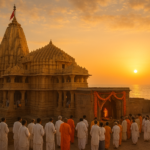
Among the countless sacred temples of India, the Jagannath Temple in Puri, Odisha, occupies a truly unique place in Hindu tradition. While the temple is one of the four sacred Char Dhams, its greatest attraction is undoubtedly the extraordinary idol of Lord Jagannath. Unlike the beautifully sculpted stone or metal idols found in most Hindu temples, the idol of Lord Jagannath has a distinctive appearance that immediately captures the attention of every devotee and visitor.
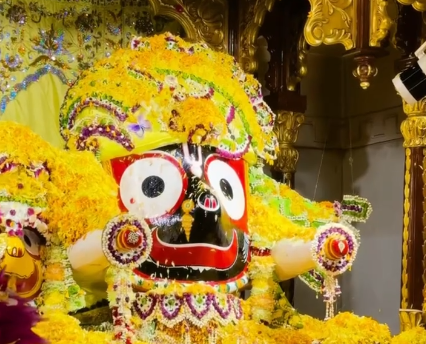
The large circular eyes, unfinished arms, absence of visible legs, broad smiling face, and wooden body make Lord Jagannath’s idol one of the most recognizable and spiritually significant images in Hinduism. For centuries, devotees, scholars, artists, and historians have been fascinated by its unusual design and the profound symbolism hidden within it.
At first glance, many people wonder why the idol looks incomplete. Why does Lord Jagannath have such large eyes? Why are the idols made of wood instead of stone? Why are the hands and legs not fully visible? Why are the idols periodically replaced through the sacred Nabakalebara ceremony?
The answers lie not in artistic preference but in a deep spiritual philosophy that has been preserved for centuries.
In this article, we explore the unique features of Lord Jagannath’s idol, its history, symbolism, religious significance, and the timeless messages it conveys to millions of devotees around the world.
1. A Sacred Wooden Idol Unlike Any Other : Lord Jagannath
The most remarkable feature of Lord Jagannath’s idol is that it is carved entirely from sacred neem wood rather than stone, marble, or metal.
Most major Hindu temples house permanent stone idols that remain unchanged for centuries. However, Lord Jagannath’s idol follows an entirely different tradition.
The sacred wooden form is known as Daru Brahma, meaning “the Divine manifested in sacred wood.”
According to temple tradition, not every neem tree can be used to create the idol. A highly sacred tree known as Mahadaru is carefully identified through elaborate religious rituals. The search is conducted by temple priests following strict scriptural guidelines and centuries-old customs.
Only after the appropriate sacred tree is found does the process of carving the idols begin.
This extraordinary tradition symbolizes that although the material body changes with time, the Divine presence remains eternal.
2. The Unique Incomplete Appearance : Lord Jagannath
Perhaps the most striking aspect of Lord Jagannath’s idol is its seemingly unfinished appearance.
Unlike conventional Hindu idols, Lord Jagannath’s form includes:
- Incomplete arms
- No visible legs
- A broad cylindrical body
- A large smiling face
- Oversized circular eyes
To someone unfamiliar with the tradition, the idol may appear unfinished.
However, spiritually, this form represents something much deeper.
The idol teaches that God cannot be confined within human imagination or physical perfection.
The Supreme Lord exists beyond all forms, dimensions, and limitations.
Rather than depicting physical beauty, Lord Jagannath’s idol symbolizes infinite divinity.
It reminds devotees that God transcends race, language, nationality, caste, and even physical appearance.
3. The Large Circular Eyes of Lord Jagannath
One of the most iconic features of Lord Jagannath’s idol is His enormous circular eyes.
These eyes immediately distinguish Him from every other Hindu deity.
Temple tradition explains that the large eyes symbolize the Lord’s ability to watch over the entire universe at all times.
Unlike human beings, whose vision is limited, Lord Jagannath sees every living being equally.
His compassionate gaze extends to every devotee regardless of social status, wealth, or background.
The eyes also symbolize divine awareness, wisdom, and unconditional love.
For devotees, merely looking into the eyes of Lord Jagannath is considered a deeply spiritual experience.

4. Eyes Without Eyelids
Another fascinating feature is that Lord Jagannath’s eyes have no eyelids.
This is not an artistic omission but an important spiritual symbol.
The absence of eyelids signifies that Lord Jagannath never sleeps while protecting His devotees.
His divine vision is constant.
His compassion never ceases.
His blessings are available to every sincere devotee at every moment.
This beautiful symbolism reminds devotees that the Lord’s grace is continuous and eternal.
5. The Ever-Smiling Face
Despite His unusual appearance, Lord Jagannath is always portrayed with a gentle smile.
His smiling face symbolizes joy, compassion, acceptance, and unconditional love.
No matter what difficulties a devotee faces in life, the smiling expression of Lord Jagannath offers hope, comfort, and reassurance.
It reflects the idea that the Divine welcomes everyone with love and kindness.
This cheerful expression has inspired generations of devotees to approach God with faith rather than fear.
6. Lord Jagannath Appears with Lord Balabhadra and Devi Subhadra
Another unique characteristic of the Jagannath Temple is that Lord Jagannath is worshipped together with His elder brother Lord Balabhadra and His sister Devi Subhadra.
Very few Hindu temples feature this divine sibling trio as the principal deities.
Their presence together symbolizes:
- Family unity
- Harmony
- Mutual love
- Protection
- Compassion
The temple beautifully reflects the importance of family relationships within Sanatan Dharma while reminding devotees that divine love embraces all.
7. The Sacred Tradition of Nabakalebara
One of the most extraordinary traditions associated with Lord Jagannath’s idol is Nabakalebara, meaning “New Body.”
Unlike permanent idols found elsewhere, the wooden idols of Lord Jagannath, Lord Balabhadra, Devi Subhadra, and Sudarshana Chakra are ceremonially replaced when specific astronomical conditions occur.
This sacred ritual is performed only after many years and follows elaborate religious procedures that have remained unchanged for centuries.
The old idols are respectfully retired, while newly carved idols become the focus of worship.
Nabakalebara symbolizes one of Hinduism’s deepest philosophical teachings:
The body changes, but the soul remains eternal.
Just as human beings leave behind one body and enter another, the Divine tradition of Lord Jagannath reminds devotees of the eternal nature of spiritual existence.
Experience Divine Darshan with Durlabh Darshan
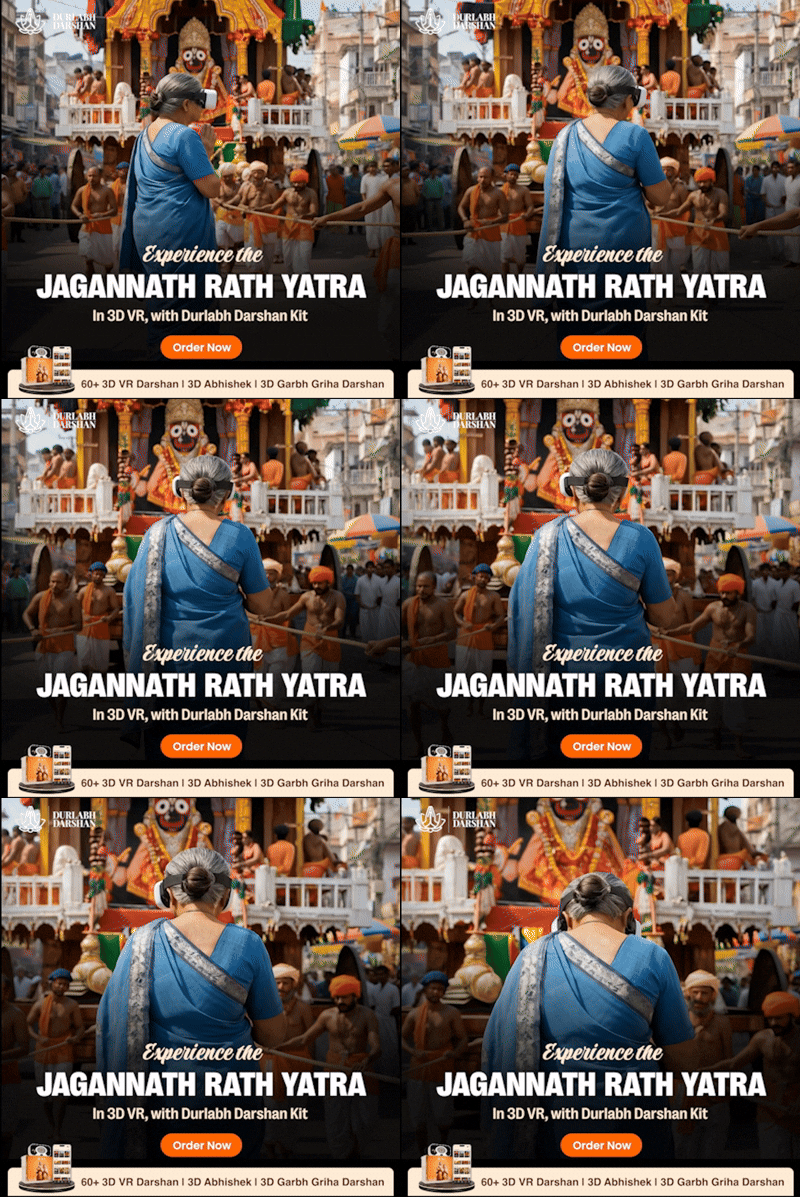
For devotees who are unable to visit sacred temples due to distance, health, or time constraints, Durlabh Darshan offers an immersive 3D VR temple experience of some of India’s most revered pilgrimage sites. While it does not replace the sanctity of a physical pilgrimage, it provides a meaningful way to stay spiritually connected and experience the divine atmosphere of these sacred temples from anywhere.
For More Information Visit :
Follow our social media handles for more such content