

Kalighat Shaktipeeth
Introduction
Kalighat Shaktipeeth, located in Kolkata, West Bengal, is one of the most powerful and historically significant centers of Goddess Kali worship in the Indian subcontinent. Unlike many temple sites that derive their importance primarily from architectural grandeur or royal patronage, Kalighat is defined by its uninterrupted continuity of devotion, dense ritual practices, and deep integration into the lived spiritual consciousness of devotees.
The temple represents a convergence of mythology, Tantra, regional culture, and urban religious dynamics. It is not merely a place where rituals are performed, but a space where the idea of Shakti—cosmic feminine energy—manifests in its most direct and intense form. The temple’s importance extends beyond religious boundaries into philosophy, anthropology, art history, and socio-economic structures of Kolkata.
This document presents an exhaustive, dense, and structured understanding of Kalighat Shaktipeeth, covering mythology, iconography, ritual systems, pilgrimage experience, Tantric framework, historical evolution, and modern relevance.
Mythological Framework and Formation of Shaktipeeths | Kalighat Shaktipeeth
The concept of Shaktipeeths originates from one of the most fundamental narratives in Hindu cosmology: the story of Sati and Shiva. Sati, the daughter of King Daksha, married Shiva against her father’s wishes. During a grand yajna organized by Daksha, Shiva was deliberately not invited. Sati attended the yajna and, unable to bear the humiliation directed toward Shiva, immolated herself in the sacrificial fire.
In grief and rage, Shiva lifted Sati’s body and performed the Tandava, a cosmic dance of destruction that threatened the balance of the universe. To stabilize the cosmos, Vishnu intervened by using the Sudarshan Chakra to dismember Sati’s body. The fragments fell across the Indian subcontinent, and each location became a Shaktipeeth.
Kalighat is identified as the site where the toes of Sati’s right foot fell. This establishes the temple not as a symbolic representation, but as a direct embodiment of the goddess’s physical presence. In Shakta philosophy, this distinction is critical, as it implies that the deity at Kalighat is not invoked but inherently present.
Evolution of Kalighat as a Sacred Site | Kalighat Shaktipeeth
The physical structure of the Kalighat temple, as seen today, dates back to the early 19th century. The temple was constructed under the patronage of local landholding families, particularly the Sabarna Roy Choudhury lineage, who played a significant role in the socio-religious development of the region.
However, the sanctity of the site predates this construction by several centuries. Early references to Kalighat appear in medieval Bengali literature and pilgrimage records. The area was originally a riverine site along the old course of the Ganga, known as the Adi Ganga. Over time, as the river shifted and Kolkata developed into a major colonial city, Kalighat transformed into an urban temple while retaining its ancient ritual core.
The growth of Kolkata as a metropolitan center further amplified the temple’s importance, making it one of the most visited religious sites in eastern India.
Architectural Layout and Spatial Organization | Kalighat Shaktipeeth
The architecture of Kalighat does not conform to the grand temple complexes seen in South India or North India’s large pilgrimage centers. Instead, it reflects a compact, functional design adapted to its urban context.
Key architectural features include:
- A sanctum (garbhagriha) housing the idol of Maa Kali
- A natmandir (assembly hall) where devotees gather
- Surrounding corridors and smaller shrines dedicated to associated deities
- Proximity to the Adi Ganga, which historically played a role in ritual purification
The temple’s layout prioritizes accessibility to the deity over monumental scale. The close proximity between the devotee and the idol creates a direct and immediate devotional experience.

Iconography and Symbolism of Maa Kali at Kalighat | Kalighat Shaktipeeth
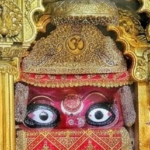
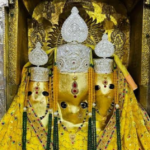
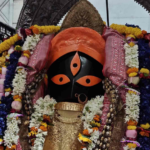
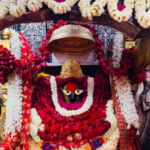
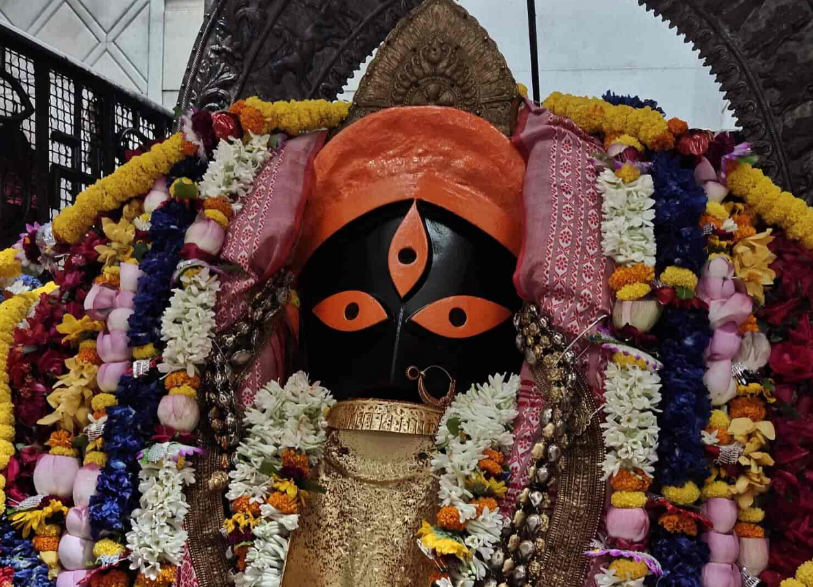
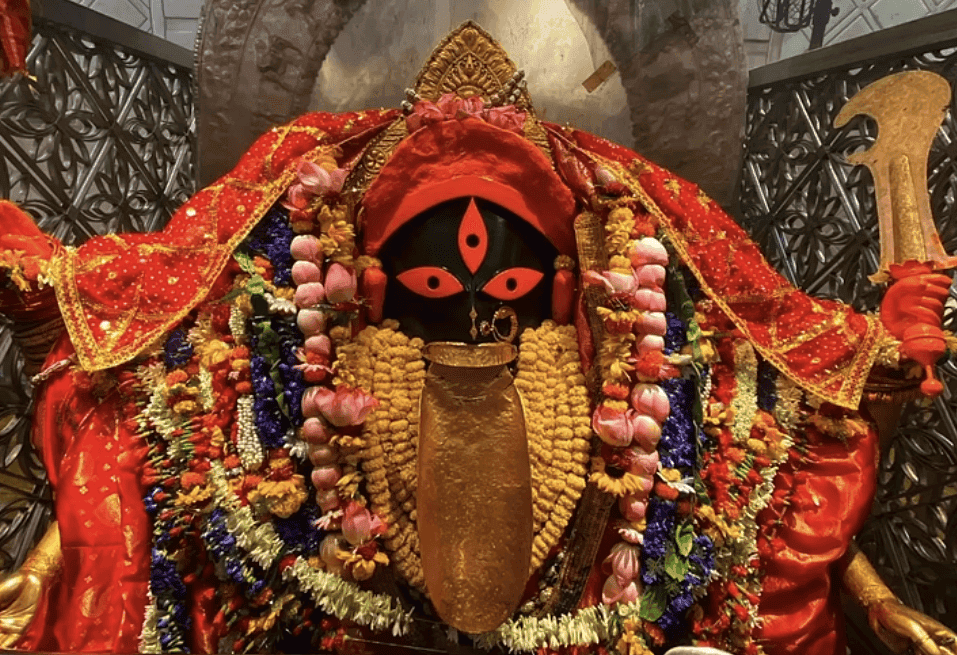
The idol at Kalighat is one of the most distinctive representations of Goddess Kali. It diverges significantly from classical sculptural depictions and instead emphasizes symbolic elements rooted in Tantric philosophy.
Primary characteristics include:
- A black stone face representing the formless and infinite nature of reality
- Large, elongated eyes symbolizing awareness that transcends time and space
- A long, protruding tongue, often plated with gold, representing both destruction and the cessation of ego
- Absence of a full anthropomorphic body, replaced by a ritualistic structure that is dressed daily
The idol is not static. It undergoes continuous transformation through decoration, clothing, and ritual processes. This dynamic nature reinforces the idea that the deity is living and responsive.
Tantric Dimensions of Worship | Kalighat Shaktipeeth
Kalighat is deeply embedded in Tantric traditions, which distinguish it from purely devotional or ritualistic temples. Tantra, in this context, refers to a system of spiritual practices aimed at transcending duality and directly experiencing the fundamental nature of reality.
In Tantric philosophy:
- Kali represents time (Kala) and the force that consumes time
- She embodies both creation and destruction
- Worship involves confronting fear, death, and impermanence
The rituals at Kalighat often include elements that may appear unconventional, such as animal sacrifice. Within the Tantric framework, these acts are symbolic representations of surrendering the lower self or ego.
Daily Ritual Structure | Kalighat Shaktipeeth
The temple follows a rigorous daily schedule of rituals that structure the flow of worship.
Morning rituals begin with Mangala Aarti, marking the awakening of the deity. This is followed by a series of offerings, including food (bhog), flowers, and symbolic items.
Throughout the day:
- The deity is bathed and dressed
- Offerings are made at regular intervals
- Devotees participate in darshan and personal rituals
Evening rituals include Sandhya Aarti, which involves the use of lamps, chants, and rhythmic movements, creating a highly charged spiritual atmosphere.
Animal Sacrifice: Context and Interpretation | Kalighat Shaktipeeth
One of the most debated aspects of Kalighat is the continuation of animal sacrifice. This practice, while controversial in modern ethical discourse, has deep historical roots in Shakta and Tantric traditions.
From a ritual perspective:
- The sacrifice symbolizes the offering of one’s inner negativity
- It represents the destruction of ego and ignorance
- It is performed under specific guidelines and restrictions
It is important to understand this practice within its cultural and philosophical context rather than through a purely modern lens.
Pilgrimage Experience and Crowd Dynamics | Kalighat Shaktipeeth
Kalighat is one of the most densely visited temples in India. The experience of visiting the temple is shaped by its urban setting and high volume of devotees.
Common characteristics include:
- Narrow approach lanes filled with vendors and pilgrims
- Continuous movement of crowds
- Short duration of direct darshan
Despite these challenges, the intensity of the experience is often described as transformative. The proximity to the deity and the collective energy of devotion create a powerful psychological and spiritual impact.
Festivals and Ritual Intensification | Kalighat Shaktipeeth
The temple reaches peak activity during major festivals, particularly Kali Puja, which coincides with Diwali.
During this period:
- The temple is elaborately decorated
- Special rituals and offerings are conducted
- Devotee turnout increases significantly
Navratri and Durga Puja also contribute to heightened activity, reflecting the broader cultural importance of goddess worship in Bengal.

Cultural and Artistic Influence
Kalighat has significantly influenced regional art forms, particularly the Kalighat painting tradition. These paintings, which originated in the 19th century, depict religious themes as well as social commentary.
The temple has also shaped:
- Local music and devotional songs
- Literary works in Bengali and other languages
- Urban identity and cultural practices
Economic and Social Ecosystem
The temple supports a complex economic network involving priests, vendors, artisans, and service providers. This ecosystem is integral to the functioning of the temple and the livelihoods of the surrounding community.
Activities include:
- Sale of पूजा items
- Ritual services performed by priests
- Hospitality services for pilgrims
Accessibility and Infrastructure
Kalighat’s location within Kolkata makes it highly accessible. It is connected by metro, road, and rail networks, allowing easy access for both local and international visitors.
However, the urban setting also presents challenges related to crowd management, sanitation, and infrastructure maintenance.
Philosophical Interpretation of Kali Worship
The worship of Kali at Kalighat represents a confrontation with fundamental existential realities:
- The inevitability of death
- The impermanence of life
- The illusion of ego
Kali is not merely a protective mother figure but a force that compels transformation. Devotion to Kali involves acceptance of both creation and destruction as integral aspects of existence.
Modern Relevance and Changing Modes of Devotion
In contemporary times, the nature of devotion is evolving. While physical pilgrimage remains important, technological advancements have introduced new ways of engaging with sacred spaces.
For a temple like Kalighat, where physical access can be challenging, digital and immersive experiences offer an additional layer of connection. These methods do not replace traditional practices but complement them by increasing accessibility.
Experience Kalighat Through Durlabh Darshan
The 3D VR streaming Durlabh Darshan app brings the temple experience closer to devotees in a way that maintains respect for tradition while enhancing accessibility.
With this experience, devotees can:
- View darshan in immersive 3D format
- Focus entirely on Maa Kali without external distractions
- Experience temple rituals in a calm and controlled environment
- Access darshan from anywhere, especially helpful for elderly devotees
This approach ensures that the essence of devotion remains intact while removing the barriers that often come with physical visits.
अधिक जानकारी के लिए:
Conclusion
Kalighat Shaktipeeth stands as a complex and multifaceted institution that integrates mythology, ritual practice, Tantric philosophy, and urban culture. Its significance lies not only in its historical origins but in its continued relevance in the lives of devotees.
The temple represents a form of spirituality that is immediate, intense, and transformative. It challenges conventional notions of worship and invites a deeper engagement with the fundamental forces of existence.
For scholars, practitioners, and devotees alike, Kalighat offers a rich field of exploration—one that continues to evolve while remaining rooted in ancient traditions.
Follow our social media handles for more such content